FIELD NOTES FROM COSTCO
observations where everyone wants the right of way and there are no rules

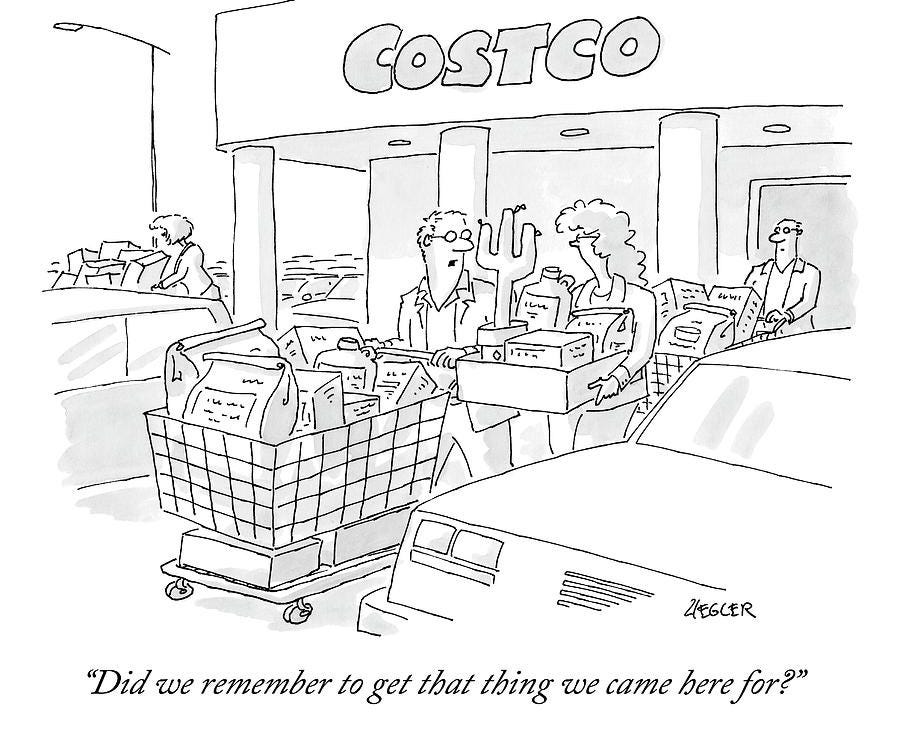
Ethnographers can learn a surprising amount about a culture by watching how it moves through a shared space. Highways reveal impatience. Roundabout cause confusion. Four-way stops reveal quiet distrust. Airports can be insane.
But nowhere does the American temperament reveal itself more fully than a Saturday afternoon inside a Costco Warehouse — where ordinary citizens can push a cart the size of a small utility vehicle and bring some of their worst road habits with them — like situational unawareness, distracted driving, and the firm belief that everyone else is the problem.
…in a place where there are no rules.
The moment people pass through the checkpoint doors something changes. Spatial reasoning fades. Peripheral vision shuts down. The ordinary rules of etiquette, fair play, and the physics of motion are quietly dismissed.
The cart itself encourages this collapse. It is less a shopping device than a steel cage declaration of abundance — and once fully loaded, it acquires dangerous physical authority, and the customers know it.
A Costco cart laden with sixty pounds of bottled water, industrial dog food, and frozen meat is subject to Newton’s law of linear motion: P = MV — momentum equals mass times velocity — which is science’s polite way of saying that once that thing starts rolling, it becomes a blunt instrument — with no brakes!
This becomes especially relevant because many of these carts appear to have been assembled with one dissenting wheel. One caster wobbles with quiet independence, and no matter how firmly you steer, the cart insists on drifting erratically like an autonomous vehicle on beta software.
Being a human, of course, you overcorrect — yet it resists like an errant child pulling you toward the candy aisle.
But wayward carts are not the only problem. Wayward customers are worse.
Humans are the independent variables here. Moving down aisle B2, I spot the first obstacle: we’ll call her the Aisle Diagonalist — the clueless shopper who always parks broadside in the middle of the lane to read the label on a pallet of olive oil or a gallon tin of peanut butter.
Predictably, traffic backs up… but no one passes. Why?
Here’s where this differs from road behavior. Americans, who would not hesitate a second to lean on the horn in traffic will wait in silence behind a blocked cart for astonishing lengths of time, apparently fearing that Excuse Me would leave them vulnerable, maybe because they’re no longer cocooned inside a 6,000 pound assault vehicle. But this attitude only makes things worse.
For example, there is a tribal segment I call The Couples. These are particularly disruptive, especially the older ones.
Costco Couples do not move through space so much as occupy it. They drift side by side — astride the cart, moving slowly… then abandon their cart midstream to hold an informal conference next to the always popular 32-pack bulk toilet paper while everyone jammed behind them is reversing and recalculating alternate routes.
And then there’s the notorious Free Sample stations, taking up precious aisle space, awkwardly positioned by Costco management for some unknown reason, but I’m pretty sure it has something to do with money.
A tray appears…
Six dumplings land on paper cups.
Almost immediately, rational adults — regular people with kids, begin orbiting around like opportunistic seagulls. People who arrived just to buy salmon and asparagus are now positioning themselves for the kill shot. Mine! Mine!
And just to be clear, most of these people don’t need more dumplings. Just look at them. If the rules of the road were enforced inside the warehouse, they would be required to have a 72-point Wide Load sign printed across their back.
And besides, I can see they already have two boxes in their cart.
That doesn’t matter. Because when the samples are free, it triggers some kind of atavism, maybe a reversion to a Lord of the Flies survival behavior.
Pro Tip: best to just avoid the sample station
Then comes the final test: transferring the cartload to the vehicle.
Here a warning is in order: a fully loaded cart on a slope carries enough potential momentum to make your insurance company recalculate your premium because—should you get distracted and let go of the cart — well, let’s just say there’s a reason they call it the LAW of Gravity. It’s not up for debate.
Later, I’m following behind the aging customers in their truck as they leave the parking lot, now burdened down by a shit load of mostly unintended bulk purchases but still proceeding with the same distracted cluelessness as they displayed earlier in the pharmacy line — slowly drifting into the left lane without signaling.
…totally unaware of the honking going on behind them.
Addendum: I was a victim of a runaway shopping cart resulting in $5k of damage. The event was captured on my Tesla SentryCam. The woman waited for me to return and accepted responsibility — but I don’t think she thought it would be so expensive.
Since then, wherever there are free range carts, I always park uphill.
Spot on! Just yesterday, I waited an interminable amount of time trying to just get by a person hovering near the sample cart, exercising extreme patience. Later, I had to nudge more than one abandoned (empty) cart out of the way to make room to get by.
Best one yet‼️